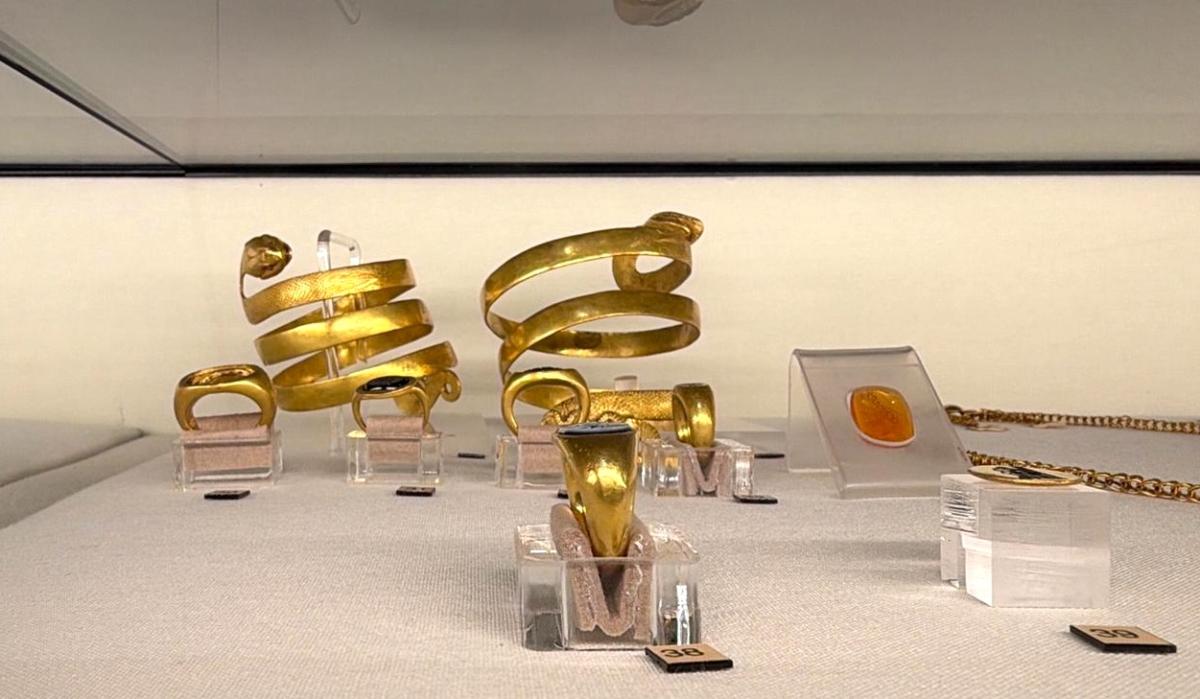
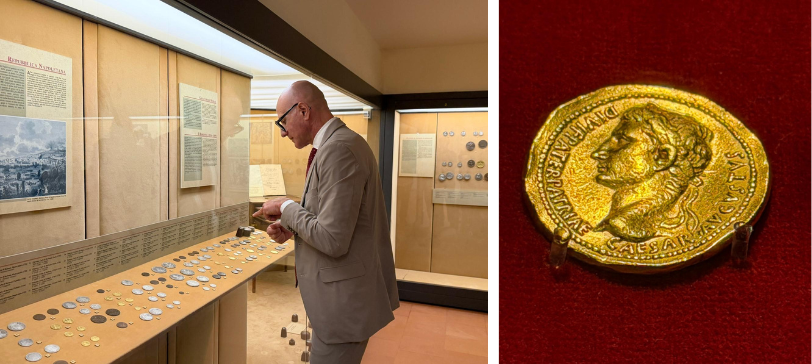
At the end of May 2026, the Numismatics section of the MANN reopened: more than six thousand coins are now on display, along with one hundred and thirty jewels and four extremely rare gold textiles made with wild silk! For everyone, the coin represents a unit of value, a status symbol, and a means of exchange to purchase basic necessities or durable and luxury goods, to make investments, and to dream by buying a lottery ticket or filling out a betting slip. Although today it is increasingly dematerialized, the coin still plays a role that goes far beyond the economic sphere: just think of the Euro and its symbolic value within the perspective of the EU.
The coin has a very long history made of technology, controls by an authority, exchange systems, scales of value, symbols and images that in some cases become masterpieces of art. Moreover, the coin has always been a true mass medium ante litteram, of enormous importance even before the rise of modern communication systems, bringing down to us characters, places, and historical events considered memorable by the ancients themselves. In short, absolutely not to be missed on your next visit to the MANN.
“Domus. The Furnishings of Pompeii”
In this issue of Polimnia, I would like to highlight a second extraordinary exhibition, inaugurated just one year ago: we are talking about “Domus. The Furnishings of Pompeii”, hosted in the rooms on the second floor. The exhibition was curated by Massimo Osanna, Andrea Milanese, and Ruggiero Ferrajoli, with the collaboration of Luana Toniolo, and it is an extraordinary, fascinating, and at the same time deeply moving journey.
Here, we step outside the history books we studied at school—full of names, dates, numbers, scattered photos, and brief indications of styles and eras, where entire centuries are boxed into a few lines—and instead enter the reality of life two thousand years ago, as if in a time machine, except that here everything is real.
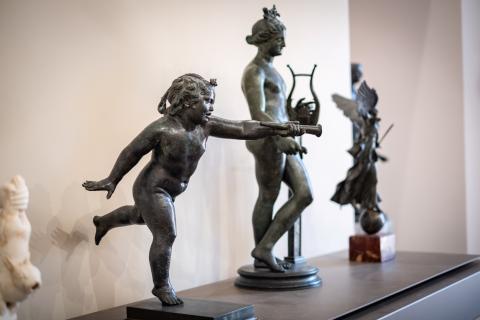
We find ourselves in front of household objects: bronzes, marbles, terracottas, and frescoes from various Vesuvian domus that strike us not only for the refinement and artistic beauty of the artifacts, but also for how they bring us back to daily life and the intimacy of domestic spaces, violated by the eruption of Vesuvius yet at the same time preserved for us.
The homes of ancient Pompeians thus become living spaces, capable of telling stories of identity, aspirations, and lifestyles. Every object on display becomes a fragment of a broader narrative—from the exceptional work of the many artisans of the time to the stories of anonymous or known families who owned it, used it, preserved it, and cared for it in their homes, generation after generation. And, just as happens today, there is the relationship with the ancient world, the one that Roman society of those years could have had: the classical tradition of Greek art from four or five centuries earlier, much as today we might appreciate a Renaissance painting.
“With this new exhibition we restore centrality to the story of ancient living,” commented last year the Director General of Museums, Massimo Osanna, “offering audiences the opportunity to enter Pompeian domus with a renewed gaze. Objects long kept in storage, many of which restored for the occasion, become visible again and take on new voice, telling stories of everyday life, taste, and representation. It is a journey that unites research, protection, and enhancement, to make the museum increasingly a living place, capable of welcoming and engaging.”
The museum’s storage rooms are vast, but the 250 artifacts on display already truly convey the sense of that time, of the objects and their functions, of their extraordinary beauty.
There are seats, stools, benches, tables, monopodia, folding tables with complex mechanisms allowing them to be transported—ingenious solutions from two thousand years ago that became common practice in the craftsmanship of later centuries, remaining unchanged over time until not many years ago, and which today are fading and evaporating in our digital civilization.
There are household utensils for utility and decoration, braziers, oil lamps, food warmers, candelabra, cups, and also sculptures, fountain ornaments, the famous oscilla, and frescoes. Beautiful. Cared for in every detail. Full of historical and artistic references to the mythology of the time, to their beliefs, to their culture.
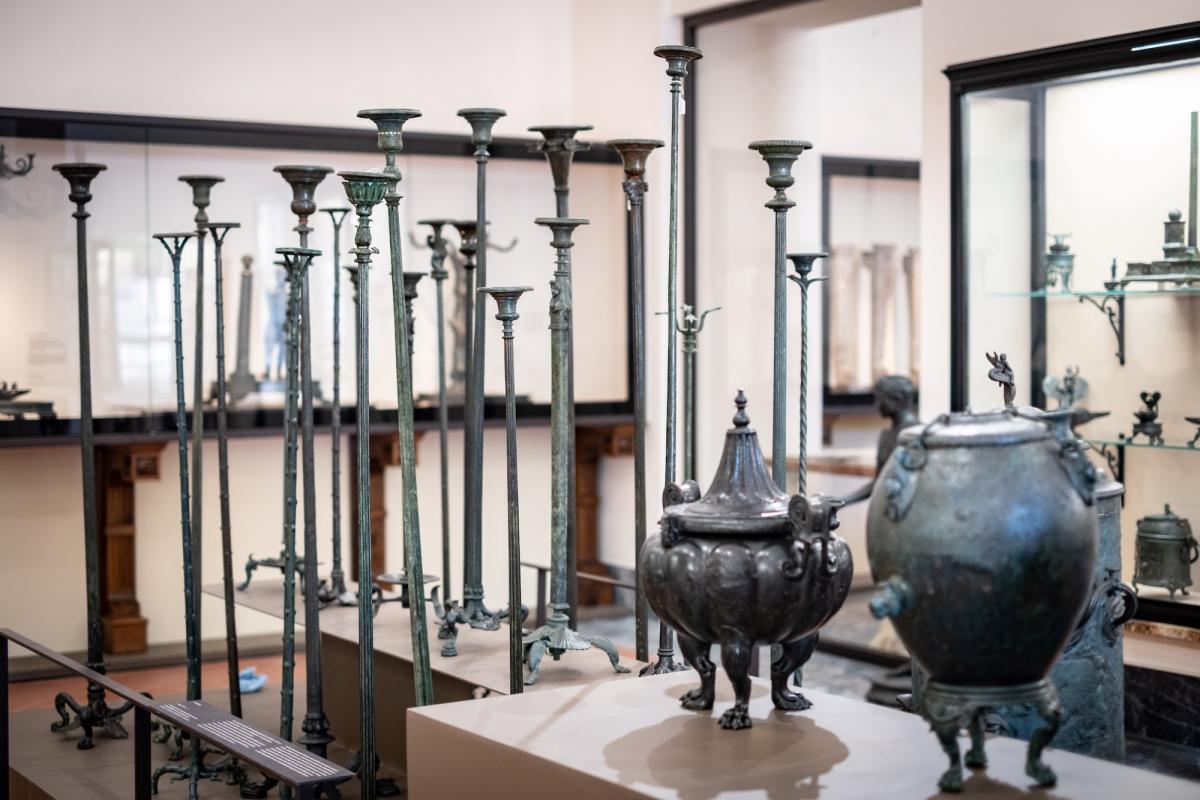
One is struck by the immortal beauty of these objects, made to last, in an era in which life expectancy—within the awareness of those contemporaries—was terribly short, yet not lived any less intensely for that reason. The exact opposite of today: longer lives and everything somewhat disposable. In an age obsessed with sustainability, we have never been so unsustainable.
Certainly, we are talking about decorative apparatuses of important houses, of wealthy families, in an era when slavery was legitimized; perhaps humanity has never truly known a real “El Dorado.” But we are also speaking of a world and a culture more universally widespread, where one need only consider the size of classical theaters—thousands of seats that could numerically contain entire communities at times.
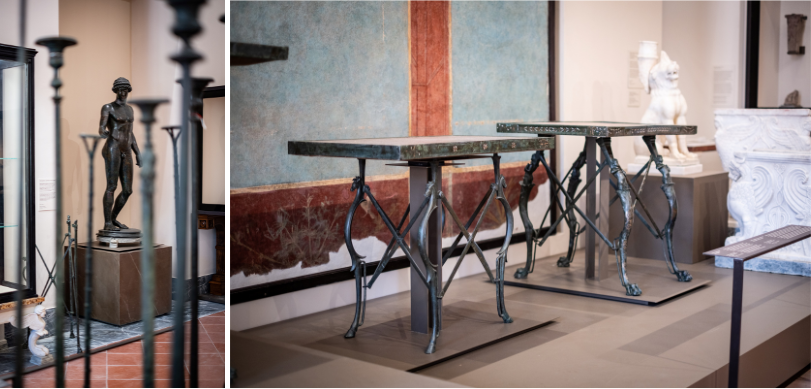
Today, art and culture often find themselves, in many circumstances, confined within spaces with objective limits; one need only recall an investigation by Corriere della Sera on art history in European high schools: it has practically disappeared almost everywhere.
We cannot therefore be surprised, or wonder whether today’s masterpiece is a banana taped to a wall with duct tape—with all due respect and admiration for Cattelan, who has the extraordinary merit of bearing prophetic witness, with the impact of a punch in the stomach as with all his previous works, to the dramatic state of things.
Not everything is lost, and to begin or begin again—like modern Raphaels with the idea of a new Renaissance in mind, as the great artist walked among the imperial ruins of Rome—the invitation is to visit without haste extraordinary places like the MANN in Naples, a true planetary oasis of civilization. And where, moreover, one eats extraordinarily well.
Roby Giannotti